Ecopsychology
is about:
- How we connect to different places;
- Why different places – especially natural ones – benefit our mental & physical health;
- Realising that what is good for us is good for the planet.
I offer consultancy in this area, to help you improve your personal, professional and event spaces.
Key terms: sustainable living; ecotherapy; restorative environments; embedment.
Why ‘ecopsychology’?
The term ecopsychology is a contraction of ‘ecology’ – the study of the interrelationships between organisms and their environment – and ‘psychology’ – the study of mental processes and behaviours – indicating that it is a blend of both. So ecopsychology can be defined as ‘the study of the interrelationships between human mental processes or behaviour and the environment within which they occur’. However, that’s a very dry, academic definition that doesn’t even start to appreciate the richness and very personal connections that ecopsychology encompasses in practice.
So a better way of defining ecopsychology is that it is about the many ways in which humans, and other animals, are an integral part of the places they inhabit. Where we are affects who we are, and we tend to be better when we're surrounded by nature (or, at the very least, natural imagery).
How is it useful?
Ecopsychology tells us:

- We are part of the natural world (often forgotten or misunderstood!)
- We feel emotionally calmer and more stable in natural, as opposed to urban, places
- We work more efficiently, with less stress, in locations which have natural elements: daylight rather than artificial lights, wooden desks rather than plastic, opening windows rather than air conditioning, and lots of plants around!
- The patterns within us are reflections of the patterns found in the world around us
- Basically, the things that make us feel at our best are also the things that are good for the environment!
Consultancy
In the area of the creation and use of restorative environments, I was a guest speaker and workshop facilitator on an International Course on Health Care Issues (Ghent University, Belgium / Instituto Plitecnico de Setubal).
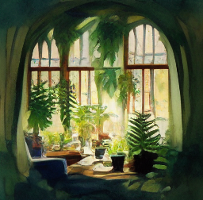
I was academic lead on the Wellbeing in the workplace initiative at Bournemouth University's Centre for Wellbeing & Quality of Life, where we created a proof-of-principle interior ‘restorative environment’ inside a modern office building. Subsequently, I was a consultant on the King’s Trust-funded Dignity in Dementia project at Poole Hospital, which created a more restorative hospital environment.
In the area of ecopsychological approaches to everyday life, I was part of the World Wide Fund for Nature working group on ‘Beyond Green Consumerism‘ and the Dorset NHS/Natural England group on ‘Our Natural Health Service‘. I have advised environmental organisations Forum for the Future, the Dorset Wildlife Trust and the Dorset Sheltered Work Opportunities Project.
Please do get in touch (contact details are at the bottom of the screen) if you are interested in creating a better environment, physically and mentally, in your workplace, home, garden, or event-space.
Further reading
- The International Ecopsychology Society: "What is ecopsychology"
- Stevens, P. (2018). A hypnosis framing of therapeutic horticulture for mental health rehabilitation. The Humanistic Psychologist 46: 258-273
- Stevens, P. (2010). Embedment in the environment: A new paradigm for wellbeing? Perspectives in Public Health 130: 265-9
- Rosak, T. (1992). The Voice of the Earth